
Indigenous poultry breeds in South Africa
Please note, we do not sell chicken breeding stock
The most common poultry breeds available in South Africa can be divided into two groups:
- Multi-purposed indigenous chickens, ideal for a free-range environment, especially rural communities. Breeds include Naked Neck, Venda, Ovambo, Potchefstroom Koekoek and Natal Game. Other European breeds such as the New Hampshire, Rhode Island Red and the Black Australorp, all can survive in this environment, although generally more susceptible to certain diseases and not as hardy.
- Breeds that are used in an intensive system for either meat or egg production. Ross and Cobb are the most common for meat production, while Hi-Line or Lohmann are the best egg producers.
Please note, we do not sell chicken breeding stock
Indigenous poultry breeds
Naked Necks

Naked Neck chickens have 30% fewer feathers than fully feathered birds (Fowls for Africa)
Records of Naked Neck chickens have been found in areas as far apart as central Europe and Malaysia. The South African Naked Neck is thought to have originated in Malaysia. These chickens have a variety of colour patterns. There are two types of Naked Necks, one of which is purebred and has a completely naked neck and the other, which is not purebred, has a tassel on the front part of the neck. If two tasselled birds are mated, one quarter of the offspring would have totally naked necks, half of them would have tassels and the remaining quarter would be fully feathered. They have a variety of colour patterns. In France the Naked Neck gene is used in commercial production as:
- They have 30% fewer feathers than fully feathered birds and can produce the same body weight with less food.
- There are fewer feathers to remove in the slaughter line and therefore they pass through much faster.
- They are more heat tolerant.
Breed and performance information
| Averages | Male | Female |
|---|---|---|
| Weight at 16 weeks | 1.5 kg | 1.1 kg |
| Weight at 20 weeks | 1.95 kg | 1.4 kg |
Sexual maturity (days) 155
Average egg weight 55.1g
Venda
While doing research in 1979, veterinarian, Dr Naas Coetzee, noticed a distinctive new breed in Venda and named it after the region. Similar chickens were later seen in the Southern Cape and in Qwaqwa. The Vendas are multicoloured with white, black and red as the predominant colours. Rose-coloured combs and five-toed feet are not uncommon. It is fairly large and lays tinted large eggs. The hens are broody and very good mothers.
Breed and performance information
| Averages | Male | Female |
|---|---|---|
| Weight at 16 weeks | 1.57 kg | 1.24 kg |
| Weight at 20 weeks | 2.01 kg | 1.4 kg |
Sexual maturity (days) 143 days
Average egg weight 52.7 g
Ovambo

Ovambo chickens originated in the northern part of Namibia and Ovamboland
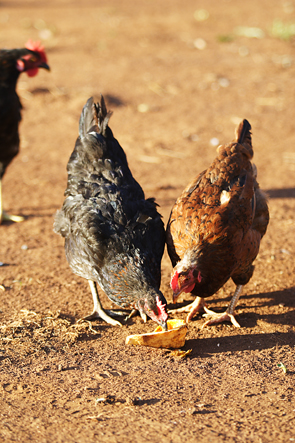
Ovambo hens come in a variety of colour compensations.
The Ovambo chickens originated in the northern part of Namibia and Ovamboland. Unlike the Venda which have white feathers, the Ovambo is dark-coloured. It is also smaller in size and it is these two differences which help to camouflage the bird and protect it from raptors. The Ovambo is very aggressive and agile. It has been known to catch and eat mice and young rats. This chicken can fly and roosts in the top of trees to avoid predators.
Breed and performance information
| Averages | Male | Female |
|---|---|---|
| Weight at 16 weeks | 1.74 kg | 1.32 kg |
| Weight at 20 weeks | 2.16 kg | 1.54 kg |
Sexual maturity (days) 143 days
Average egg weight 52.5 g
Egg production 129 eggs per year
Potchefstroom Koekoek

Potchefstroom Koekoek hen and cock

The Koekoek chick’s sex can be identified as the females are completely black, while the males have a white spot on the head.
The term “Koekoek” describes the colour pattern. The Koekoek’s colouring is present in as many as nine different breeds. The feather colouring is sex-linked, making it very useful in breeding programmes. If a black or red cock is crossed with a Koekoek hen, the sexes of the offspring can be separated when the chicks are only a day old. Sexes can be identified as the females are completely black, while the males have a white spot on the head. The Potchefstroom Koekoek was bred locally from crosses between the black Australorp and the White Leghorn.
Breed and performance information
| Averages | Male | Female |
|---|---|---|
| Weight at 16 weeks | 1.84 kg | 1.4 kg |
| Weight at 20 weeks | 2.4 kg | 1.7 kg |
Sexual maturity (days) 130 days
Average egg weight 55.7 g
Egg production 198 eggs per year
Source – Fowls for Africa (ARC-Animal Production Institute Tel: 012 672-9111)